Why Does My Well Water Smell Like Rotten Eggs? Causes and Fixes
Rotten egg smell from your taps? Find out whether it is your well or your water heater, and which treatment removes hydrogen sulfide.


Some links on this page are affiliate links. If you buy through them we may earn a commission, at no extra cost to you. How we make money.
You turn on the tap or step into the shower and get a blast of rotten eggs. It is one of the most unpleasant well water problems, and one of the most common. The smell comes from hydrogen sulfide gas, and your nose is extremely sensitive to it: Penn State Extension notes that most people can smell it at levels well below 0.5 mg/L.
Before you spend anything, you need to know where the smell is coming from. Sometimes the cause is the well itself. Often it is your water heater, and that is a much cheaper fix. This guide walks through how to tell, and what works for each cause.
The short answer
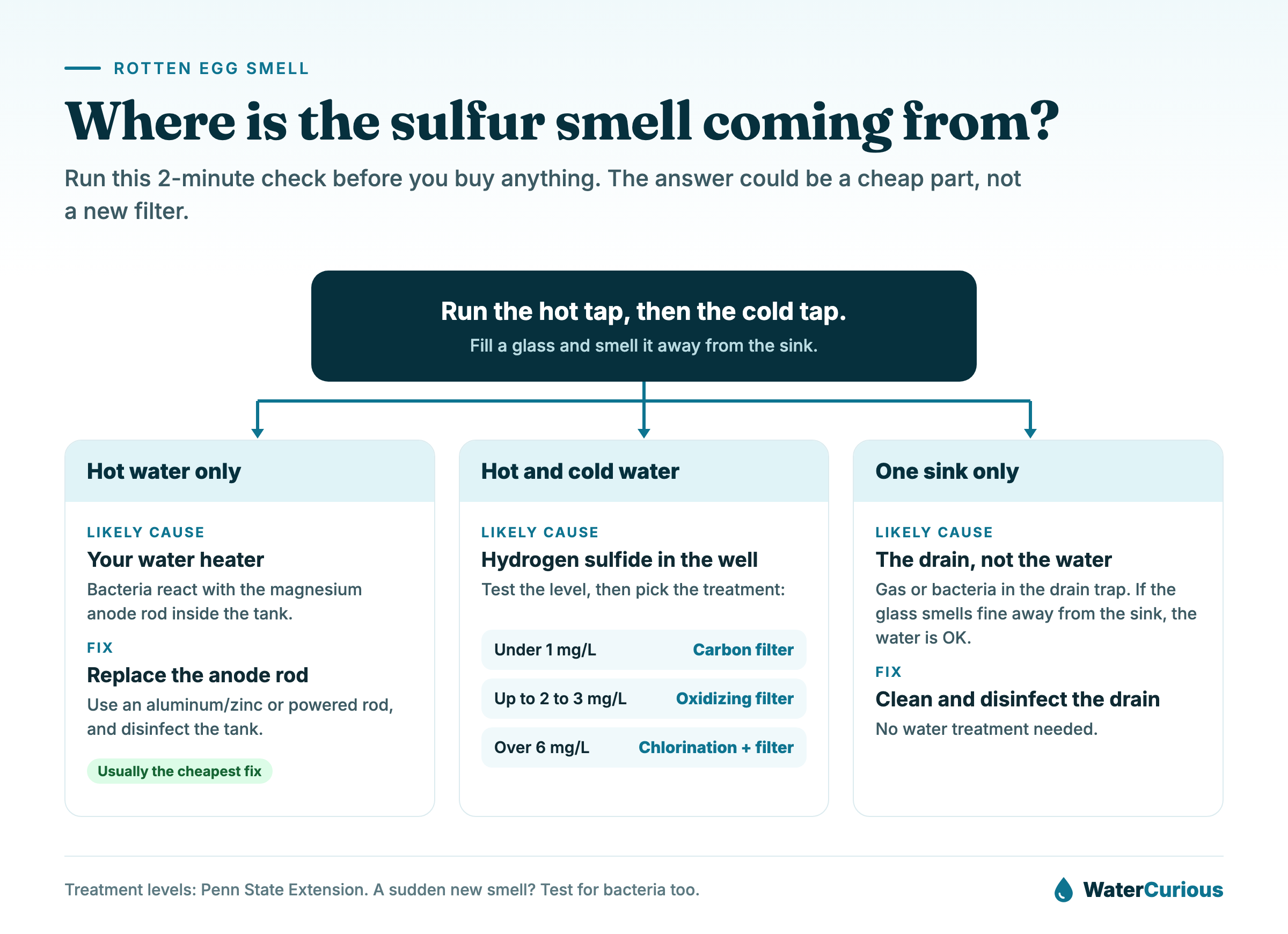
- Hot water only? The cause is almost always your water heater. Replacing the anode rod usually fixes it.
- Hot and cold? The hydrogen sulfide is in your well water and needs treatment.
- One sink only? It may be the drain, not the water.
- Treatment depends on the level (Penn State Extension): carbon filters below about 1 mg/L, oxidizing filters up to 2 to 3 mg/L, chlorination for high levels, usually above 6 mg/L.
- Test for bacteria too. A new or changed smell can be a sign of other problems.
Is rotten egg smell in well water dangerous?
At the levels usually found in household wells, hydrogen sulfide is a nuisance rather than a health threat. You will smell it long before it reaches a harmful level in your water. It does cause real problems, though:
- It makes water and anything cooked in it taste and smell bad.
- It is corrosive. It tarnishes silverware, blackens copper and brass fixtures, and attacks metal pipes.
- It can leave black stains on fixtures and laundry.
- It fouls water softeners and some filters.
Treat a new or sudden smell as a reason to test. Sulfur-reducing bacteria and surface water contamination can come together, so it is worth checking for coliform bacteria at the same time. Our well water testing guide explains how.
Where is the smell coming from? A 2-minute check
Run this check before you buy anything. It tells you whether you need a new anode rod, a drain clean or a treatment system.
| What you notice | Most likely cause | What to do |
|---|---|---|
| Smell from hot water only | Your water heater. Bacteria in the tank react with the magnesium anode rod and produce hydrogen sulfide. | Replace the anode rod, and disinfect the tank if needed. |
| Smell from hot and cold water, at every tap | Hydrogen sulfide in the groundwater, or sulfur bacteria in the well. | Test, then treat at the well (see below). |
| Smell from one sink or shower only | Bacteria or gas in the drain, not the water. | Fill a glass, walk away from the sink and smell it. If the glass is fine, clean the drain. |
| Smell only on softened water | Bacteria growing in the softener. | Clean and disinfect the softener. |
| Smell strongest first thing in the morning or after time away | Gas builds up in water sitting in the pipes or tank. | Usually points to the well or the water heater. Test to confirm. |
Fixing a smelly water heater
If only your hot water smells, the cause is usually inside your water heater. Most heaters contain a magnesium anode rod that protects the tank from rusting. When sulfate-reducing bacteria in the water meet that magnesium in a warm tank, they produce hydrogen sulfide.
The common fixes are:
- Replace the anode rod with an aluminum/zinc or powered anode. These are designed to cut down the reaction that causes the smell. Don't simply remove the anode rod: it protects the tank, and removing it can shorten the heater's life and void the warranty.
- Disinfect the tank with a chlorine or hydrogen peroxide flush to kill the bacteria, following the manufacturer's instructions.
- Turn the temperature up for a period, following the manufacturer's guidance, to kill the bacteria. Take care: high temperatures are a scalding risk.
If you are not comfortable working on a water heater, this is a quick job for a plumber.
How to remove hydrogen sulfide from well water
If both hot and cold water smell, you need to treat the water itself. The right system depends mostly on how much hydrogen sulfide is in it, so get it tested first. Hydrogen sulfide escapes from a sample quickly, so follow your lab's instructions closely, or ask a water treatment professional to test on site.
| Hydrogen sulfide level | Typical treatment | Notes |
|---|---|---|
| Under about 1 mg/L | Activated carbon filter | Simple and cheap, but the carbon fills up and needs replacing. Better for faint smells. |
| Up to about 2 to 3 mg/L | Oxidizing filter (air injection, greensand or catalytic media) | The usual whole-house fix. Also removes iron and manganese. Some sources rate these filters for higher levels. |
| Above about 6 mg/L, or very variable | Chlorine or hydrogen peroxide injection, then filtration | Handles any level and also kills sulfur bacteria. Needs the most upkeep. |
Levels from Penn State Extension. The Minnesota Department of Health and Purdue Extension give higher limits for some oxidizing filters, so check each system's rating against your test results.
Activated carbon filters
Carbon absorbs hydrogen sulfide and works well for faint smells. The weakness is that it fills up quickly when levels are high, so you end up changing filters often. A whole-house cartridge system such as the iSpring WGB21BM combines a carbon block with an iron and manganese stage, which suits a light sulfur smell alongside a little iron.
Oxidizing filters (the usual whole-house fix)
An oxidizing filter turns hydrogen sulfide into tiny particles of sulfur, then traps them in a bed of media and flushes them out on a timer. Air injection (AIO) filters do this with a pocket of air at the top of the tank, with no chemicals to buy. Because iron, manganese and hydrogen sulfide often appear together, one oxidizing filter can usually deal with all three. See our guide to iron in well water for more on these systems.
- Crystal Quest's Metal Removal Whole House Water Filter is designed for iron, manganese and hydrogen sulfide together, and started at around $1,331 at the time of writing. Their full iron, manganese and sulfur range includes smaller cartridge systems.
- Air injection filters such as this Fleck 5600SXT air injection iron and sulfur filter are a popular do-it-yourself option.
Mid Atlantic Water's video compares the main ways to remove a sulfur smell:
Chlorine or hydrogen peroxide injection
For strong smells, a small pump feeds chlorine or hydrogen peroxide into the water. It oxidizes the hydrogen sulfide and kills sulfur bacteria, then a filter removes the particles. A carbon filter afterward usually removes any leftover chlorine. This handles the worst water, but the dose needs setting correctly and the system needs regular attention.
Shock chlorination for sulfur bacteria
If the smell comes from sulfur bacteria living in the well rather than from the groundwater itself, shock chlorinating the well can clear it, at least for a while. Bacteria often come back, so the smell returning weeks or months later is a sign you may need continuous treatment.
What about a water softener?
A softener won't remove hydrogen sulfide, and the gas can foul the softener's resin. If you have hard water and a sulfur smell, put the sulfur treatment first and the softener after it.
Frequently asked questions
Why does my well water suddenly smell like rotten eggs?
A sudden smell can follow a change in the water table, heavy rain, a new water heater or anode rod, or a period without using the water. It can also mean bacteria have started growing in the well or plumbing. Test for bacteria and hydrogen sulfide to find out.
Why does only my hot water smell like sulfur?
Because the smell is being made in your water heater. Bacteria in the warm tank react with the magnesium anode rod. Replacing the anode rod with an aluminum/zinc or powered rod, and disinfecting the tank, usually fixes it.
Is it safe to shower in water that smells like sulfur?
At normal household levels, hydrogen sulfide in water isn't considered a health risk, though it is unpleasant. If the smell appeared suddenly, test for bacteria as well, to make sure nothing else has changed.
Will a whole-house carbon filter remove the sulfur smell?
For low levels, yes. For stronger smells the carbon fills up quickly and needs frequent replacing, so an oxidizing filter is usually better value.
Does boiling remove the sulfur smell?
Boiling drives some of the gas out, but it is not a practical fix for a whole house. It also doesn't deal with whatever is causing the smell.
How much does a sulfur filter cost?
Carbon cartridge systems start at a few hundred dollars. Whole-house oxidizing filters usually cost from around $1,000 to $2,500 before installation. Injection systems cost more and need more upkeep. Replacing a water heater anode rod usually costs much less than any of these.
Sources
- Penn State Extension: Hydrogen sulfide (rotten egg odor) in water wells
- Minnesota Department of Health: Hydrogen sulfide in well water
- Purdue Extension: Hydrogen sulfide in drinking water (WQ-11)
- Government of New Brunswick: Rotten egg smell in well water