Well Water Testing: What to Test For, How Often and What It Costs
What to test your private well for every year, the extra tests for your area, home kits vs certified labs, costs, and what to do if a test fails.
Some links on this page are affiliate links. If you buy through them we may earn a commission, at no extra cost to you. How we make money.
If your water comes from a private well, nobody else is checking it. The federal Safe Drinking Water Act covers public water systems, not private wells, so the job of testing falls to you. Nearly 40 million Americans are in that position, according to the U.S. Geological Survey.
The good news is that well water testing is cheap, simple and mostly a once-a-year job. This guide covers exactly what to test for, when to test, whether a home kit is good enough, and what to do with the results.
The short answer
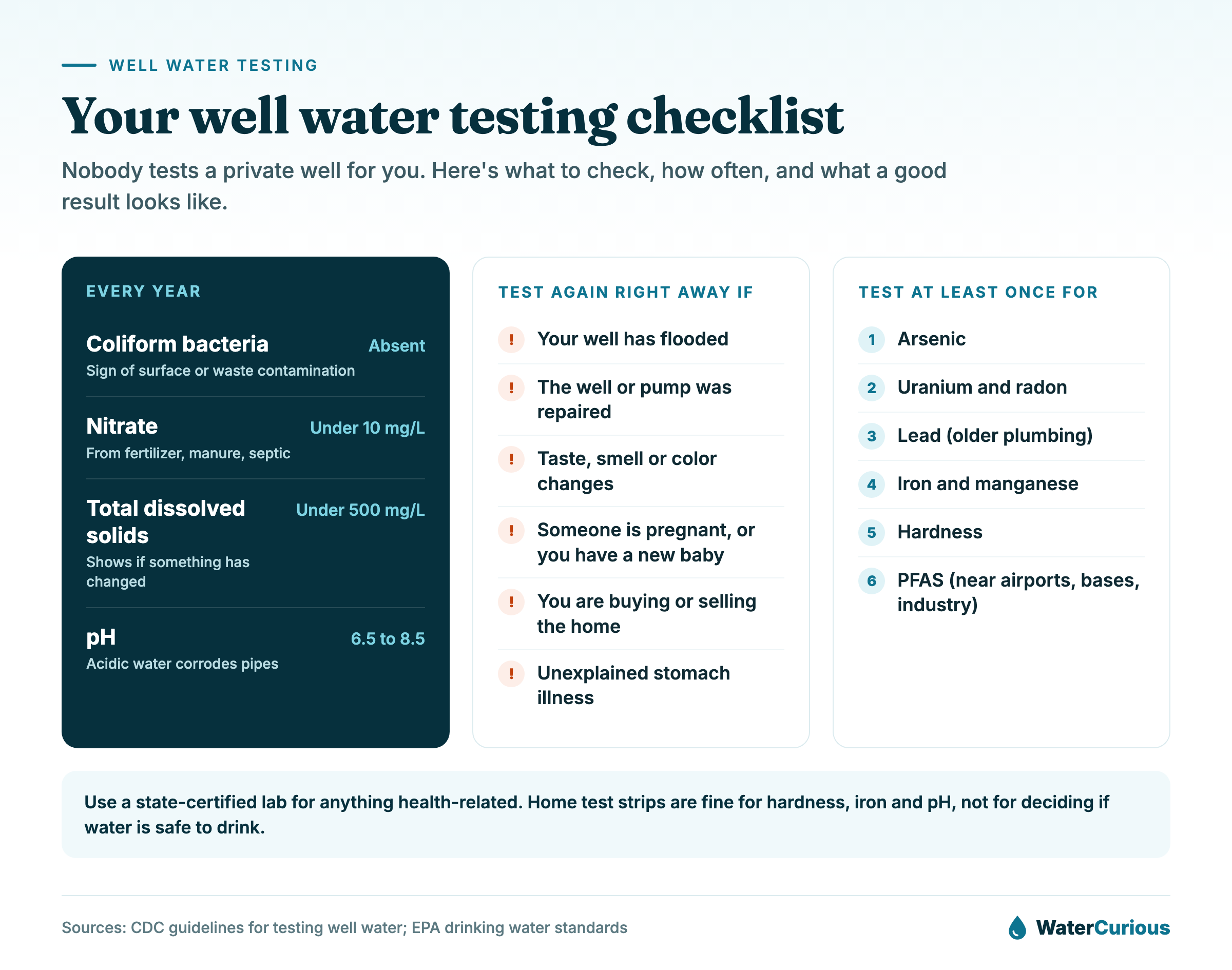
- Every year: test for total coliform bacteria, nitrate, total dissolved solids (TDS) and pH. This is the CDC's baseline.
- At least once, then every few years: test for contaminants common in your area, such as arsenic, uranium, lead, manganese or PFAS.
- Straight away: after flooding, well repairs, a change in taste, smell or color, or when someone in the house is pregnant or has a new baby.
- Use a state-certified lab for anything health-related. Home test strips are fine for screening hardness and iron, not for deciding whether water is safe to drink.
- Expect to pay roughly $20 to $90 for a basic bacteria and nitrate package, and a few hundred dollars for a comprehensive lab panel.
Why you need to test your own well
City water is tested by the utility many times a year, and the results are published. A private well gets none of that. The EPA is clear that private well owners are responsible for the safety of their own water.
Most well water problems give no warning. Bacteria and nitrate have no taste, smell or color, and neither do arsenic, lead or PFAS. Water can look perfectly clear and still fail a basic test. Testing is the only way to know.
It also matters for your equipment. A filter or softener chosen without a test is a guess. The right treatment depends entirely on what is in your water, so a test should always come before you buy anything.
What to test well water for every year
The CDC recommends testing your well at least once a year for four things. Together they catch the most common health risks and tell you whether something has changed underground.
| Test | Why it matters | What a good result looks like |
|---|---|---|
| Total coliform bacteria (and E. coli) | Coliform bacteria are an indicator. Their presence means surface water or waste may be getting into your well. E. coli specifically points to fecal contamination. | Absent (none detected) |
| Nitrate | Comes from fertilizer, manure and septic systems. High levels are dangerous for babies under six months and during pregnancy. | Below 10 mg/L (as nitrogen), the EPA limit |
| Total dissolved solids (TDS) | A general measure of everything dissolved in the water. A sudden jump suggests something has changed. | Below 500 mg/L (EPA secondary guideline) |
| pH | Acidic water corrodes pipes and fixtures and can pull lead and copper into your water. Very alkaline water tastes bitter and leaves scale. | 6.5 to 8.5 (EPA secondary guideline) |
Most state, county and university labs sell a "homeowner" or "basic well" package that covers exactly these tests, often with hardness and a few others added.
Extra tests to add for your situation
The yearly basics don't cover everything. Many of the most serious contaminants are geological or local, so it is worth running a broader test at least once, then repeating it every few years or whenever something changes. Your state health department or county extension office can tell you what is common where you live.
| If this applies to you | Add these tests |
|---|---|
| Orange or brown stains, metallic taste | Iron and manganese |
| Black stains or black specks | Manganese |
| Rotten egg smell | Hydrogen sulfide and sulfate (and sulfate-reducing bacteria) |
| White scale on faucets, spotty dishes | Hardness |
| Blue-green stains in sinks or tubs | Copper and pH (usually acidic water) |
| Home plumbing built before 1986, or old brass fittings | Lead and copper |
| Farmland, livestock or a septic system nearby | Nitrate (more than once a year), pesticides |
| Granite or other bedrock areas, including much of New England, the Southwest and the Upper Midwest | Arsenic, uranium and radon |
| Near an airport, military base, landfill or industrial site | PFAS |
| Near gas drilling, a road salt store or the coast | Chloride, sodium and TDS |
A few of these deserve a closer look:
- Arsenic is natural in some rock formations and has no taste or smell. The EPA limit is 10 micrograms per liter (10 parts per billion). Wells in the same neighborhood can have very different levels, so a neighbor's result is not a substitute for yours.
- Lead usually comes from your plumbing rather than the well itself. The EPA's health goal for lead is zero, because no safe level is known.
- PFAS are "forever chemicals" used in firefighting foam and many products. In 2024 the EPA set limits of 4.0 parts per trillion for PFOA and PFOS in public water. In May 2026 it proposed keeping those two limits while dropping the limits for four other PFAS and giving utilities more time to comply. The rules don't cover private wells, but the numbers are a useful benchmark for your results. PFAS testing is specialist and costs more, so it makes most sense if you live near a likely source.
- Manganese stains at low levels, and at higher levels it is a health concern, especially for infants. The EPA's health advisory level is 0.3 mg/L.
When to test outside your yearly check
Test again straight away, even if your last result was clean, when:
- Your well has been flooded, or floodwater came near the wellhead.
- The well, pump or plumbing has been repaired or replaced.
- The water changes in taste, smell, color or clarity.
- Someone in the household is pregnant, or you have a baby under six months. Test for nitrate and bacteria before using well water for formula.
- Someone in the house has unexplained stomach illness.
- There has been a chemical spill, new drilling or major construction nearby.
- You are buying or selling a home with a well. Some states and many lenders require a test, so check early.
- You have just installed treatment equipment. Testing afterward confirms it is doing its job.
Home test kit or certified lab?
Both have a place, but they do different jobs.
Home test strips and kits are quick and cheap. They are good for screening things you can act on yourself, such as hardness, iron, pH and chlorine, and for checking between lab tests that a filter or softener is still working. Their weakness is accuracy: color charts give rough ranges, results depend on lighting and timing, and a negative strip result is not proof that water is safe to drink.
A state-certified laboratory uses approved methods and gives you exact numbers you can compare with EPA limits. For anything health-related, including bacteria, nitrate, arsenic, lead, uranium and PFAS, a certified lab is the right choice. If you ever need to show results to a lender, buyer or health department, they will expect a certified lab report.
| Home strips and kits | Certified lab | |
|---|---|---|
| Typical cost | Low (one kit covers many tests) | Roughly $20 to $90 for a basic package; more for full panels |
| Speed | Minutes | Days to a couple of weeks |
| Accuracy | Rough ranges | Exact values with detection limits |
| Best for | Hardness, iron, pH, checking a filter still works | Bacteria, nitrate, arsenic, lead, uranium, PFAS, home sales |
Good options for each
- Your local certified lab. This is usually the best value. Many county health departments and extension offices sell kits and handle the shipping. Your state's drinking water lab certification office keeps the official list of certified labs, and the EPA links to every state's list.
- Mail-in comprehensive panels. If you want a broad test in one go, kits such as the Safe Home Ultimate Drinking Water Test Kit send your sample to an EPA-certified lab for a large panel of contaminants. They cost more than a local basic package but cover far more.
- Home strips for screening. A multi-parameter strip kit such as the Varify 17-in-1 Water Test Kit is useful for hardness, iron and pH checks between lab tests.
- A quick bacteria check. Home bacteria kits like the Safe Home DIY Bacteria Test are handy for a re-check after you disinfect a well. For your annual test, use a certified lab.
How much does well water testing cost?
Prices vary by state and lab. As a guide, at the time of writing:
- Penn State's agricultural lab charges $70 for a package covering total coliform, E. coli, pH, TDS and nitrate.
- The University of Wisconsin-Stevens Point lab lists a 2026 homeowner package at $78, covering coliform bacteria, nitrate, pH, alkalinity, hardness, chloride, conductivity and corrosivity.
- Some county health departments and extension offices offer a bacteria-only test for less. A few states and counties offer free or subsidized testing, especially after floods. Ask your local health department.
- Comprehensive panels covering metals, minerals and organic chemicals usually cost a few hundred dollars. PFAS testing is often priced separately.
Set against the cost of a treatment system, a test is cheap. It is also the only way to avoid buying equipment you don't need.
How to collect a well water sample
Bad sampling is the most common reason for a false result, especially for bacteria. Always follow your lab's own instructions, but the usual steps are:
- Use the lab's bottle. Bacteria bottles are sterile and often contain a small amount of preservative. Don't rinse them out.
- Choose the right tap. Use a cold-water kitchen or bathroom tap that doesn't leak. Avoid swivel faucets, hoses and outdoor spigots. Remove the aerator or screen.
- Bypass treatment if you want to test the well itself. Water from after a softener or filter tells you about the treated water, not the well. Some people test both.
- Run the cold water for a few minutes to flush water that has been sitting in the pipes, then reduce the flow to a steady stream.
- Fill to the line without touching the inside of the bottle or cap. Close it straight away.
- Keep it cold and get it to the lab quickly. Bacteria samples should be tested within about 30 hours of collection, so check which days the lab accepts samples before you start.
This short video from the Minnesota Department of Health covers when and how to test:
How to read your well water test results
Lab reports look intimidating, but you only need to check a few things on each line:
- Units. mg/L is the same as parts per million (ppm). µg/L is parts per billion (ppb), so 10 µg/L equals 0.010 mg/L. PFAS are measured in nanograms per liter, which is parts per trillion (ppt).
- "ND" or "<" values. "Not detected" or a less-than sign means the level was below what the lab can measure. That is usually good news.
- The limit column. Most reports show the EPA limit next to each result. Primary limits (MCLs) are health-based. Secondary limits cover taste, odor and staining, and are not health limits.
- Bacteria results. These are usually "present" or "absent". Any positive coliform result means action, even if E. coli is absent.
Penn State Extension's walk-through of a real water test report is worth a watch before you open yours:
What to do if your test fails
Bacteria present. Stop drinking the water, or bring it to a rolling boil for one minute before drinking or cooking (three minutes above 6,500 feet), until the problem is fixed. Check the wellhead for a damaged cap or cracked casing, then have the well disinfected, usually by shock chlorination, and retest. If bacteria keep coming back, a permanent fix such as a UV system may be needed.
Nitrate above 10 mg/L. Don't use the water for infant formula, and don't boil it: boiling concentrates nitrate rather than removing it. Use bottled water for babies and pregnant women while you find the source and look at treatment such as reverse osmosis.
Arsenic, lead, uranium or PFAS above the limit. Boiling won't help with these either. Use another water source for drinking and cooking, talk to your state or local health department, and choose a treatment system certified to reduce that specific contaminant.
Only nuisance problems such as iron, manganese stains, hardness or sulfur smell. These are about comfort, appliances and staining rather than immediate safety (with the exception of high manganese). Your test results tell you exactly which kind of filter or softener you need, and what size.
Frequently asked questions
How often should I test my well water?
At least once a year for bacteria, nitrate, TDS and pH, as the CDC recommends. Test for local contaminants such as arsenic or uranium at least once, then every few years. Test again straight away after flooding, repairs or any change in your water.
What is the best time of year to test?
Spring is a good choice, because snowmelt and rain are when surface water is most likely to reach a well. Testing at the same time each year also makes results easier to compare.
Can I test well water myself?
You can screen for hardness, iron and pH with home strips. For bacteria, nitrate and other health-related contaminants, collect the sample yourself but send it to a state-certified lab.
Does boiling make well water safe?
Boiling kills bacteria and other germs, so it is the right short-term step after a positive bacteria test. It does not remove nitrate, lead, arsenic or other chemicals, and it can make them more concentrated.
Is a well water test required when buying a house?
It depends on your state and your lender. Some states and many mortgage lenders require a test before closing. Even when it isn't required, it's worth doing before you buy, because fixing a problem can be expensive.
Who can test my well water for free?
Some state and county health departments offer free or reduced-cost testing, particularly after floods or in areas with known contamination. Contact your local health department or county extension office.
Sources
- CDC: Guidelines for testing well water
- EPA: Protect your home's water
- EPA: National primary drinking water regulations and secondary standards
- EPA: PFAS drinking water regulation
- EPA: State certification programs and certified drinking water labs
- USGS: Domestic (private) supply wells
- Penn State Agricultural Analytical Services Lab: Drinking water testing
- UW-Stevens Point Water and Environmental Analysis Lab: Testing for homeowners and private well owners
This guide is general information, not medical advice. If your results show a health risk, follow your state or local health department's guidance.